Personal essay published in ti-TCR 20: On Collective Care edited by Emma Jeffrey, The Capilano Review, Fall 2024. Free to access, with the option to donate to Islamic Relief Canada’s Gaza Emergency Appeal, which provides urgent aid to displaced civilians in Gaza.
Edging in the Abyss (2021)
1.
Bodies activated. Bodies, a shape-changing storage room. My body is an endless fragmented story to uncover and reorganize. Multiple layers of violence, loss, and expectation are projected onto the body and handed down through generations. We are so porous, we can slip in and out of place and time. Sometimes I have no body. Bodying. To be a part of something. There is an overemphasis on penetration; bodies are translation; that is, bodies are not about filling holes, but about expunging from them. Puke and shit. Body as translation. Body as archive and archivist; gathering materials. Obsession with what enters the body.
Porous: (Of a rock or other material) having minute spaces or holes through which liquid or air may pass. Not retentive or secure.
The penetrated body is in crisis. Albeit archive and archivist, it struggles to hold and be held. Making language to make a bed, a place to dwell.
Lina Mounzer:
Of course I believe in language and its importance, even for survival! It’s probably one of the few things I believe in without question or doubt. I come back, again and again, to Mahmoud Darwish’s Memory for Forgetfulness, written about and from within the Israeli invasion and bombardment of Beirut in 1982. I look to it as a handbook on writing about war in many ways. In the book, Darwish expresses repeatedly the desire for “a language that I can lean on and that can lean on me, that asks me to bear witness and that I can ask to bear witness.”
Lina Mounzer, in conversation with Mirene Arsanios, “Writing in Crisis: A Conversation Between Beirut and New York,” Lithub.com, September 1, 2020.
2.
I ease my way out the door to walk the crying dog. The smell of heat makes it worth it and the sun always helps to sort things out.
Last night I asked habibi about Lebanon. She said we have nothing to compare it to in physical life. The power that went out the night before—only wifi lost. Across the street, no power at all and it’s hardly a semblance. This is diaspora. Last family meal, I asked about Lebanon. Mom said she had one hour of electricity a day growing up. Her numbness grows my frustration.
I am in a constant motion of thinking about my thoughts. It is exhausting. Like the dog at the window sill ready to go off. Everyday I spell the bones of poems that will never meet their flesh. No essay. No photograph. No film. No collaboration.
The smell of summer is tinged with smoke. When the musk is not making it difficult to breathe, it is a ripe undertone awaiting its fervent decay. The sound of mowing lawns tricks my mind to forget about the smell of garbage. My dog investigates. My stomach hurts. What reverence does the sky hold today?
An image is just an image. What empathy may my skin bear? I am sick with longing and want Beirut back.
Sarah Rifky:
What is this writing? I wonder… We write it, because it helps us understand the world with the aid of narrative. Naming a curious incident allows it to be less strange. It contains it, in a word, a little box, labeled Curious Incidents. When I read news reports about current events, I wonder if there is a cache of feeling, a daily quota of empathy, that if used up too quickly leaves us devoid of feeling for days to come. Reading the news drains us of our empathy. Writing is restorative. There are more texts being written than ever before and more than will ever be read. Writers are not the diary keepers of uprisings, and even the best writing is corrupt, it steals time from other things, like making soup with filmmakers.
Sarah Rifky, The Going Insurrection / Der gehende Augstand, 100 Notes—100 Thoughts, (dOCUMENTA (13), 2012), 8.
3.
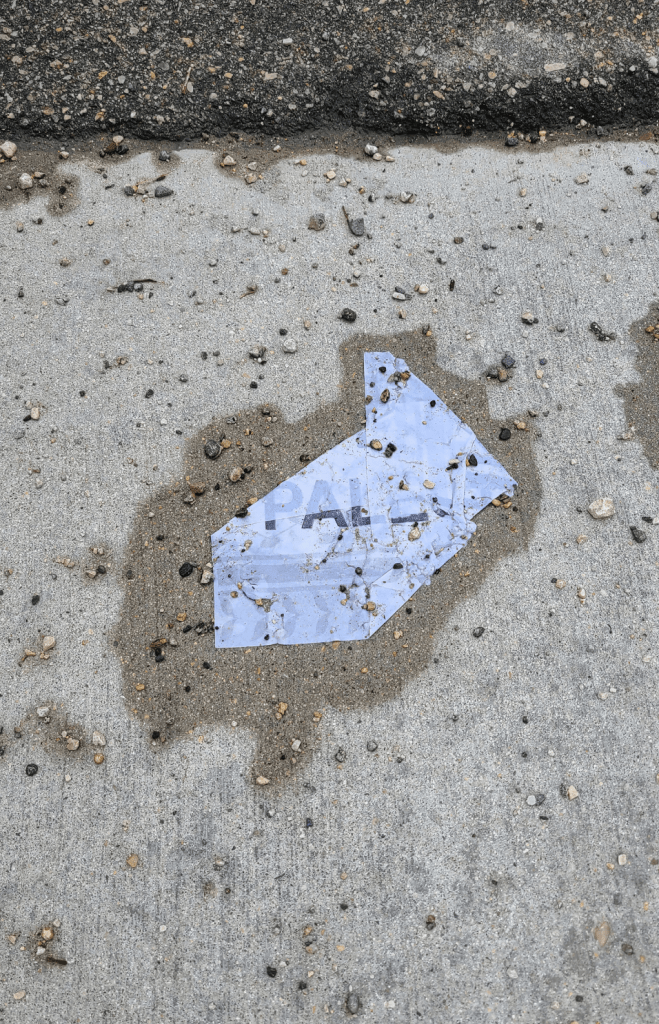
Let the record show, I did not go to work but I worked. I have been fired from so many jobs. Now I am chilling and doing freelance. I grow wiser. I grow more and more into a State-hating bitch. I write mental elegies and light the joint. I freefall. I am building a vision of myself in you. When I walk the dog, I take pictures of antiracist posters defaced in the neighbourhood. I find my FREE PALESTINE posters torn down. In the presence of absence, I point my sentimental lens. Today I found one, cradled in the grass. Shook down by weeks of wind and rain. A soft miracle. Yet even natural death is violent.

4.
Most days, walking is easier than writing. When I finally get outside, the effort becomes well worth it. Like as a child when I refused to shower. Writing is a false presence. No, writing is in motion. I write because I do not have words. Where does the artist/writer/curator turn? Multitudes of expression clowning for mere indecision. Co-star tells me I’m a non-verbal thinker and I feel seen.
My baby rests his head on my legs as I type. He rests his head and I count the years of his too-short life, always grieving with anticipated loss. I am learning to say goodbye because I am no good at goodbyes. I am learning to say goodbye because I know what it is like to not have the chance.
I buy countless books and read none of them. I buy bagged salad and it grows rotten in the fridge. The sunrise is putrid with the morning breath of regret. We all know growing wiser is a tired disillusionment. All my favourite people are bitter and even astrology betrays me.
The dog crying at the door. The cutest, most annoying sound.
5.
Sawako Nakayasu:
Say what is the smallest unit of translation, say word, say syllable, say phoneme, say orthography, say handwriting, say breath, say particle of thought preceding articulation. Say what is the largest unit of translation, say poem, say book, say all the books, say everything they ever wrote, say everything they never wrote, have yet to write, say the transit between everything they ever wrote and everyone who ever reads anything they ever wrote, or say something larger more vast.
Sawako Nakayasu, Say Translation Is Art (Ugly Duckling Presse, 2020).
I can feel you trying to reach me, and I want to know what you are trying to say. My self-swaddle loosens its grip for your attention and affection. I shapeshift into a vessel of infinite starry nights, awaiting your grace. It’s all here. We are looking for a language that already exists. The immortality of translation makes it so. No nihilism may survive the rushing waters of this plenitude. I am brimming with the solace of surrender, the reverence of leaning in and seeping out—that I might live another day to gaze at the altitude of desire, beyond the gardens of grief at my shore.
The first section of this text was written in a C Magazine workshop entitled “Perverse Conversions: A Workshop on Criticism, Translation, and Play,” during a one-on-one free-writing exercise in which my partner read from Julietta Singh’s No Archive Will Restore You. All photos courtesy of the author (2021).
 Christina Hajjar